

Gluten has become one of the most talked-about topics in nutrition, but for many people, the real question is whether their body is truly reacting to it, and if so, why.
Celiac disease is an autoimmune condition that affects an estimated 1 in 133 Americans, or about 1% of the population. And it can occur at any time in a person’s life.
While celiac disease and gluten sensitivity can share similar symptoms, they are not the same condition. Understanding the difference can help bring clarity, support better decisions, and make it easier to approach food in a way that feels both informed and balanced.
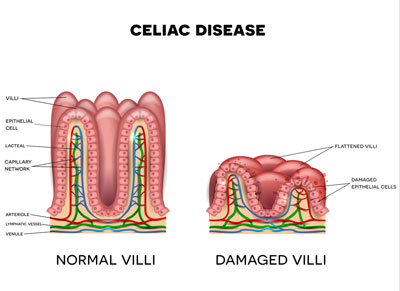
When a person with celiac disease consumes gluten, their system sees it as a threat and mounts an attack. The villi of the intestines become damaged, preventing nutrient absorption, often resulting in malnourishment and other problems. The only real solution is to remove gluten from the diet altogether.
Many people might have gluten sensitivities yet don’t test positive for Celiac disease. These individuals can also have various health issues, ranging from bloating to headaches to fatigue.
To find out if you have a gluten sensitivity or possibly celiac disease, ask yourself the following questions:
1. Do you experience frequent bloating or gas?
2. Have you ever been diagnosed with IBS or acid reflux?
3. Do you have daily diarrhea or chronic constipation?
4. Do you experience frequent migraines or headaches?
5. Do you experience joint pain?
6. Do you have problems concentrating or staying focused?
7. Have you dealt with depression and anxiety?
8. Do you often feel fatigued?
9. Do you suffer from chronic eczema or acne?
If you answered yes to four or more of these questions, it’s possible that you could have celiac disease. It’s also possible that you have gluten sensitivity. Consulting your doctor is one way to know for sure, as they can test you for celiac disease immediately. If you test negative, the next step may be to have you eliminate gluten from your diet for 2 to 4 weeks to determine if your symptoms subside. If you answered yes to only one or two of these questions, eliminating gluten from your diet might still be worthwhile to see if your symptoms disappear.
Every body responds to food a little differently, and understanding those differences takes patience, awareness, and sometimes professional guidance.
Whether someone is living with celiac disease, gluten sensitivity, or neither, the goal isn’t fear around food—it’s learning what helps the body feel supported, nourished, and well. Often the most helpful approach is the one rooted in balance, clarity, and listening closely to what your body is trying to tell you.